Please visit All Saints Wolfeboro’s YouTube Channel to view sermons shared with the liturgical community church God has gathered in the beautiful Lakes Region of New Hampshire.
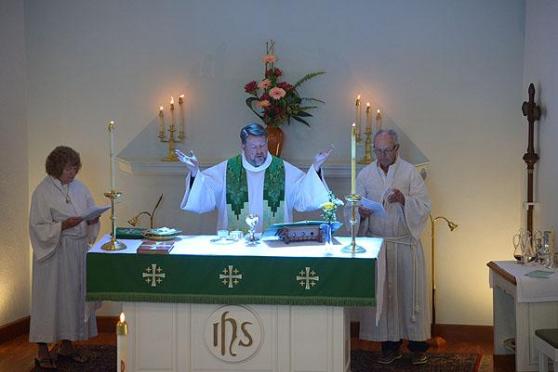
Please visit All Saints Wolfeboro’s YouTube Channel to view sermons shared with the liturgical community church God has gathered in the beautiful Lakes Region of New Hampshire.
 In the Gospel reading for Sunday, June 7th from Mark 3 (2B Pentecost), we are encouraged to take seriously the power of evil present in our world. But we are to take more seriously (trusting with all who follow and do the will of God) that it is Jesus who embodies the power of God. Jesus’ work of casting out demons is ascribed as demonic, or from the devil. Mark warns that blasphemy, or ascribing to the devil that which is divine, is a sin that cannot be forgiven. But this contrasts with other biblical passages that indicate that God always forgives us.
We do have a tendency though to judge those who abuse alcohol, drugs, or others sexually or violently as somehow “possessed” by demons. We demonize others as monsters and condemn them by ostracizing them in the media, in prisons, and even through murderous retribution. Some would say Dzhokhar Tsarnaev, the Boston Marathon Bombing monster got what he deserved with the death sentence.
If we are made in God’s image (and God says we are), we cannot be monsters. If we do the will of God, we are called to cast out demons and bring healing, not called to demonize, judge, or kill one another. Christian singer-songwriter Sufjan Stevens reminds us we are both saint and sinner in his bold and haunting song “John Wayne Gacy, Jr.” about the serial killer…
And in my best behavior I am really just like him.
Look beneath the floor boards for the secrets I have hid.
It is easy to demonize others especially when they do evil, but as Aleksandr Solzhenitsyn reminds, “the line between good and evil runs through our hearts.” Thankfully, Jesus casts out all our demons, forgives all the secrets we have hid, and loves us no matter how many saintly or sinful things we have done, because we are as Jesus calls us his mother or brother, made in God’s image and called to do God’s will.

Holy Week is the most important week of the year for those of us who follow the way of Jesus the Christ. It is a week of incredible highs and lows as we end the lenten journey to the cross. As the sun sets and we experience the darkness of Jesus’ death, we are called to gather with other Christ followers to keep vigil and await the breaking of a new day.
But many will not fully experience Holy Week by going from picking up palms to Easter eggs. I feel sorry that for those who skip the three days of Maundy Thursday, Good Friday and the Vigil of Easter, often missing the point of the week we call Holy. The experience of Holy week is likened to attending a parent or grandparent’s big birthday bash and celebrating, but not seeing that same loved one at the end in their suffering and death. Some may even skip the wake (others the funeral itself) and instead go right to the lunch or reception because they want to remember their loved one “the way s/he was” and avoid the messiness of the realities of life.
I encourage you to be reminded of the realities of life, and death, and resurrection through Holy Week and the three-day experience of Maundy Thursday, Good Friday and the Great Vigil of Easter. Skipping these for me it is like listening to Christmas music in November, eating Marshmallow peeps in Lent, or eating a Fenway Frank purchased in the grocery store and cooked at home. The true joy and life-giving meaning consumed out of context for me is as hollow as those chocolate bunnies whose ears I’m tempted to bite off today.
Holy Week culminates in the Great Vigil of Easter as we gather to hear God’s ancient story, to pray, to sing, and to remind one another of God’s promises of being with us and loving us, no matter what. We struggle with believing those promises some days, and that is why the vigil service is so rich—rich in liturgical ways to travel the way from darkness to light, from uncertainty to joy, from death to life. The vigil connects God’s story to ours through emotional and intense stories from Hebrew Scripture.
The vigil is shaped by stories, but words are not the only focus as there are rich multi-sensory experiences and images accompany the journey from death to life. Vivid elements of fire, water, earth, and air are featured…
Through the vigil experience, we hear anew that God’s story and those of the people of the promise is our story too. God’s life-giving Word will wash over us with God’s promises and salvation. I encourage you to attend Holy Week Services near you and if you happen to be in New Hampshire, join us at All Saints’ Wolfeboro Saturday, April 4th at 7:00 pm.

In Colonial America some pews were set aside as general seating for special groups. Details varied according to town, location, date and circumstances but they included reserving seats for adolescents, Native Americans, the poor, widows, the hard-of-hearing, prisoners, and black people, whether enslaved or free. In most churches, even here in New England, the last pews were commonly called Negro Pews and often labelled “free” or “Negro.”
New Hampshire was no exception to this custom. Negro Pews were features of the old North Meetinghouse, which stood on Market Square Portsmouth from 1711 to 1854. The Negro pews there were high above the front door in the upper balcony, as far as possible from the pulpit. And slave owners had to purchase pew space for their slaves just as they had to for themselves. Negro pews were found in other churches and continued in 1807 when St. John’s Church was built. The pews in a church that is the oldest today in our Episcopal Church of New Hampshire were properly identified with brass labels engraved “Negro Pews.”
You see our ancestral Episcopalians in New Hampshire followed a hierarchical system which expressed “dignity” in terms of proximity to the pulpit. The placement of Negro Pews against the back wall of the balcony declared black people’s status as the lowest order of a hierarchical white society. I bet it was hard to breathe up there after climbing all those stairs.
There were a few New England churches that placed Negro Pews in the side balconies, a highly-visible location usually reserved for adolescents and unmarried young adults. Placing blacks here gave physical expression to the white perception of black people as childlike, untrustworthy, or given to inappropriate behavior. This attitude became an enduring fixture of white culture. It was expressed as recently as the mid-20th-century when the term “boy” was used to exclude grown black, gay or Jewish men from mainstream culture or to imply their place at the bottom of society among children.
Black people left Portsmouth Churches in the 1890’s when the first black church was established. But this was just a different, out of sight, out of mind form of segregation, you’ve heard the term “separate but equal.” Some churches gradually left behind segregation practices but the brass “Negro” labels remained in St. John’s until long after the practice of separate seating had long lapsed. Their disappearance reflected our societies growing white embarrassment about past sins. [http://www.seacoastnh.com/blackhistory/slaves3.html#1]
+ + +
But Pastor Bill, what does this have to do with All Saints’ or our texts? Well repentance about past segregation we didn’t participate in, doesn’t mean that racism wrongs have been righted, or that you and I are not called to reflect and repent for those thoughts and actions known and unknown, things we have done and things we have failed to do around power, privilege and prejudice, the sin that perpetuates oppression based on race. Repentance is what John calls us to this day. John called people to repent, to clean-up the practices of our lives and to completely reorder our thoughts so that nothing will get in the way of the Lord’s coming. The reading from Isaiah gives the context for this radical call:
 Micah 6:8 is one of my favorite verses in all of scripture. I’m not alone as many writers list it as one of the top 10 due to its focus on doing instead of just thinking about faith. In North America and even in the Vatican these days there is a shift from religion as being something one studies and thinks about, to being faith experienced and lived. Even our own Evangelical Lutheran Church in America uses the tag-line God’s Work. Our Hands. to articulate and encourage this shift in religious life.
Many want religion to be a simple, a bunch of rules to follow, a prayer to say, a formula to happiness, wholeness, and heaven. Just tell me what you want from me, what I need to do… Preachers on television use this model: believe this, don’t do that, act this way and God will bless you, God will give you what you want, what you’ve earned, and your life as a “Christian” will be full of perfection and prosperity. But you and I know that God isn’t a puzzle to be solved or a program to be worked.
God who created us and loves us, pursues us as we wander and wonder about what we need to do. God sent prophets to shape us up and assure us of God’s blessings. And when we ignored them and insisted on our way, God send Jesus to save us from our sins and ourselves. Today we hear from Micah and Matthew Messages to realign us and remind us of what God does for us first, what God dreams and hopes our response is, and both of those are love.
+ + +
In my experience as a student, my writing teachers always stressed the importance of using strong verbs to make your point. In Micah that verb is “require”. It’s a word we know well. It focuses us on what one needs to do and serves to focus and direct the verse:
what does the Lord require of you…?
Seems pretty easy to understand, but here is where the nuances of language, particularly the original Hebrew get in the way. Sure it would be easy to tell you to:
do justice, and to love kindness, and to walk humbly with your God.
THAT is what the Lord requires, wants, and demands.
Reformation Sunday + October 27, 2013

When I told the Wednesday Faith Night Bible Study group this week that my working title for this Reformation sermon was “Who’s Your Daddy?” their reaction was similar to yours. Admittedly it’s an unusual, maybe edgy title, but it reflects a central question in John’s Gospel today.
The people of the promise who believed in Jesus had just heard him say that by living out the word he’d taught them, they would truly be his disciples. Disciples who would experience the truth and the truth would set them free. Well they didn’t get it, claiming that as sons and daughters of Abraham they’d never been slaves to anyone. I wonder if Jesus laughed-out-loud because he, like most Sunday school children, know that the people had been enslaved, and more than once…
Descendants of Abraham never enslaved—I imagine Jesus smiling and maybe shaking his head as he asked them: “Who’s Your Daddy?”
Who’s Your Daddy according to that all-knowing web resource Wikipedia, is a slang expression that most often takes the form of a rhetorical question. It is commonly used as a slam, an insult, and a boastful claim of dominance over the intended listener. Perhaps the phrase itself comes from the 1968 song “Time of the Season,” by The Zombies (yes pastor used a zombie reference during Halloween week) that features the lyrics:
What’s your name? Who’s your daddy? Is he rich like me?
And as we struggle to keep our eyes open after watching the World Series game last night (especially if you’re a Red Sox fan), you may recall the phrase from the 2004 American League Championship Series when it was used as a taunt chanted by New York Yankees fans at Boston Red Sox pitcher Pedro Martínez. Now Most of you know that I’m not a Yankees fan, but Pedro brought this on himself after losing a game against the Yankees when he told reporters:
They beat me. They’re that good right now. They’re that hot. I just tip my hat and call the Yankees my daddy.
I don’t care if you are the world’s biggest Yankees fan, or George Steinbrenner Jr., the Yankees are not your daddy. Nor is Abraham your daddy. Distant ancestor, biblical hero and father figure yes, but not even daddy to the Jewish people Jesus was engaging in our Gospel story this morning. So “Who’s Your Daddy?” We are children of God, that’s who our daddy is!
Word. Jesus, God with us in the flesh came to remind us of that. Jesus tells us that as children of God, we are no longer subject to the world’s boastful claim of sin and dominance over us.
+ + +

Ancient Celtic Christians used the Wild Goose as an image for the Spirit of God. As a Christ follower of Scotch Irish descent, I can imagine my ancestors arguing that the traditional image of the Holy Spirit, the dove was well, too tame. Doves are pretty and often depicted as clean and white. But wild geese are, well, wild. They get down in the water and mud in their untamed, unpredictable and unleashed noisy way. One cannot miss the presence of a wild goose. The Spirit of God is not caged as the institutional church has most often perceived her to be, but is unleashed, honking and chasing us all to notice God in the wind, water and mud of life.
As a mainline church pastor, the Wild Goose of God has been circling around my comfort zone and nudging my thinking about the future of faith in the post-Christian context we live in. My Lutheran theology of the cross and experiencing God where we least expect, moved my exploring continuing education and retreat options from those offered by the religious establishment, to something a little more, well, wild. As I searched and prayed, I found the Spirit of God sending me to the Wild Goose Festival. For that, I am thankful.
It was in the wild and beautiful mountains of North Carolina last week that this Christ follower was affirmed, challenged, and energized for my work as a parish pastor through four days of music, justice, spirituality and art. The festival flew on the wind and wings of the metaphor for the unpredictable Spirit of God as we engaged in the theme of ReMembering the Body. The incarnational images of God were abundant…
The reality show that documents the struggles of people who cannot part with their belongings and highlights the intervention and roads they take to recovery could be a model for the Church. The show does not sugarcoat that hoarding is a serious pathological condition. Instead, the show connects hoarders with professionals who then recommend treatment and resources to recovery based on the specific needs of the people who struggle with hoarding.
The Church has experienced declining membership and participation, and many long for recovery. For some that longing is for recovery to the vibrant peak of denominational Christianity of the late sixties and seventies. Few would admit that the Church is suffering a pathological condition, but we are. We hoard and hold on to dusty buildings and traditions that are falling down and overflowing with outdated stuff. We are not unlike the Church of five hundred years ago that got rid of the stuff that got in the way of the Good News, taking the road of recovery called the Reformation.
Today those of us on that Reformation road have become as pathological as the Roman Catholic Church of the 1500’s. We have a history of hoarding regardless of which Protestant side street we may have taken. We have complicated our current condition with pathological denial that recovery must include casting off, letting go, and finding new roads. While the A&E show highlights the struggle, freedom and new life that comes along the hoarders’ recovery road, we know that the road runs through the Cross and Resurrection.
As traveling the Reformation Road has been slowed down by our pathological conditions, some of our fellow travelers like authors Diana Butler Bass and Phyllis Tickle have served as traffic reporters in much the same way as loved ones do on the A&E show. Both point to the Good News of the Cross and Resurrection as the GPS on the recovery road. Tickle sees new expressions of church emerging on the map and encourages existing ones to explore the roads of reconfiguration and revitalization.
Our denomination leaders are called to positions to serve as therapists and coaches that help us see and get rid of the stuff we have been hoarding and holding onto. On the television show, not all hoarders survive the recovery road, but as resurrection people, the questions and lessons from Hoarders can be a road map for the Church…


There is a new worshipping community being developed in a closed Lutheran church building in the South Wedge neighborhood of Rochester, NY that I think Paul would love. Their website and Facebook page describe themselves in this way:
NOW OFFERING IN WORD AND SACRAMENT:
+SAFE HAVEN FOR THE RELIGIOUSLY HOMELESS+
+WORK FOR THE SPIRITUALLY UNDEREMPLOYED+
+GRACE FOR ALL – NO EXCEPTIONS+
Faith Lutheran Church is currently considering a welcome statement that reflects Paul’s letter to the worshipping community in Galatia. In what many consider to be Paul’s most decisive statement declaring that faith in Jesus has removed all barriers to a relationship with God. All are welcome to be a part of the way of Jesus. God graces followers with faith no matter who they are, no matter what their religious resume or spiritual stature.
Paul reminds us that God gave the law to Moses to keep us in line, to provide rules like we would find in a classroom. So Moses was like a school teacher who God gave to discipline us. But we, like school children across the country this month sing that classic Alice Cooper hard rock classic: Schools Out For Summer…
NO MORE PENCILS, NO MORE BOOKS, NO MORE TEACHER’S DIRTY LOOKS.
We want our summers free. We want to do what we want, when we want, with whom we want. And like our fellow ancestors of Abraham and Sarah who were given school teacher Moses, we wander and sing “schools out for the summer” in the way we live our lives.
That Alice Cooper classic continues with words that come from living life apart from God…
WELL WE GOT NO CLASS. AND WE GOT NO PRINCIPLES.
AND WE GOT NO INNOCENCE. WE CAN’T EVEN THINK OF A WORD THAT RHYMES.
SCHOOLS OUT FOR SUMMER. SCHOOLS OUT FOREVER.
God saw that we like naughty school children, broke the rules and ran wild during the summer, no matter how harsh the discipline. But God loved us and doesn’t leave us alone to run wild. We are so loved that instead of permanent detention, God with us, Jesus, joins us in summer school to make us all God’s children. You and I, children of our heavenly Father, are as Paul reminds, heirs of all God’s promises to Israel.
+ + +
We are all children of God, as are the religiously homeless and spiritually underemployed. If only those 75% of our religiously homeless neighbors would join us here…
After all, all are welcome here…right?
For most who participated in Wednesday Faith Night discussions in Lent, engaging in really looking at who is here, who is not here, and why, the welcome statement we are considering makes sense. For others who have not wrestled with the issues of welcome and hospitality at Faith, if we just say “all are welcome,” that covers it. But the reality is there are people across the fence and across the dinner table from us that do not feel welcome in the church, any church, even this one. We are most comfortable welcoming and sharing hospitality with people like us much of the time. We long for things the way they used to be, when this community was more homogeneous, but God has gathered us here in East Hartford, a diverse and rapidly changing mission field.
The Christian church has often condemned and excluded people because of race, culture, age, gender, economic status, disability or sexual orientation. While the Church has made progress by being open and affirming to many groups, there continues to be condemnation, exclusion and segregation in many communities of faith. Where there is not, there is often tolerance of condemnation, exclusion and segregation through silence. We good people of Faith have been silent. Continue reading

 Signs Along the Way…